
Every cabin cost breakdown treats roofing as a single line item: "$X per square foot, moving on." That's fine for a rough budget. It's useless when you're standing at the lumber yard trying to decide between a $400 roll of roofing felt and a $2,000 pallet of standing seam panels for the same 400-square-foot roof.
This is a materials-first breakdown. No cost-per-square-footage-of-the-whole-house tables, no permit talk, no foundation comparisons — just roofing, ranked by real dollars, with the tradeoffs that determine whether "cheap" today costs you double in year 12.
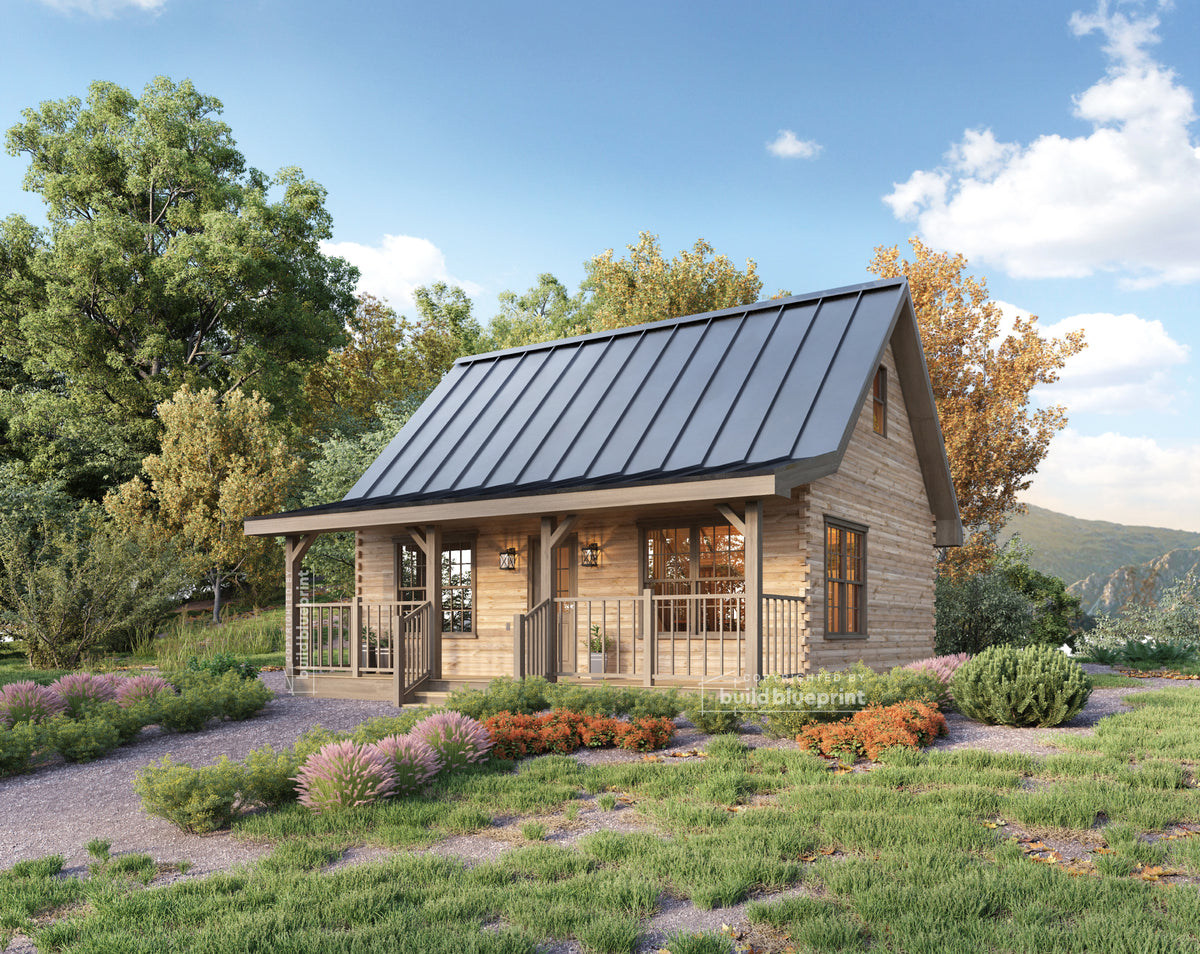
Worth knowing up front: every plan in the Budget Cabins collection is drawn with a simple, standard roofline on purpose — fewer valleys, hips, and dormers means less flashing, less waste, and lower labor no matter which material you pick below.
Cheap to Install vs. Cheap Over 20 Years
These are not the same answer. Roll roofing wins on upfront cost by a wide margin. Standing seam metal wins on cost-per-year-of-service. Which one is "cheapest" for you depends on whether you're building a weekend retreat you'll re-roof without blinking, or a place you want to leave alone for three decades.
The Caveat You Need Before You Trust Any of These Numbers
The cost data below comes from residential roofing industry cost guides — meaning it's built from full-house re-roofing jobs, not small new-construction cabin roofs. That matters in both directions:
- Your roof is smaller, so total material cost will likely land at the low end of these ranges or below it.
- You lose economy of scale on labor. Contractors often have minimum job costs, and setup/teardown/delivery fees don't shrink just because your roof is 400 sq ft instead of 2,000. A small job can cost more per square foot installed than these averages suggest — which is exactly why DIY installation matters more for a cabin than it does for a house.
Treat every number below as a directional range, not a quote. Get actual pricing from a local supplier for your specific roof size before you finalize a budget.
Cost Comparison: Roll Roofing vs. Shingles vs. Metal
| Material | Materials Only (per sq ft) | Fully Installed (per sq ft) | Typical Lifespan |
|---|---|---|---|
| Roll roofing | $0.50 – $1.50 | $2.00 – $5.50 | 5 – 20 years |
| Asphalt shingles | $1.00 – $2.00 | $3.00 – $5.00 | 15 – 30 years |
| Corrugated metal panels | $1.00 – $5.00 | $5.00 – $12.00 | 30 – 45 years |
| Standing seam metal | $3.50 – $7.50 | $9.00 – $16.00 | 30 – 50+ years |
Source ranges: residential roofing industry cost guides (see note above on applying these to small cabin roofs).
Roll Roofing: The Cheapest Option, Full Stop
Roll roofing (asphalt-saturated felt or mineral-surfaced rolls) is the lowest upfront cost material by a wide margin — $2.00 to $5.50 per square foot installed, and materials alone can run under $1.50 per square foot.
- DIY-friendliness: The best of any option here. It installs with a hammer, utility knife, roofing cement, and galvanized nails — no specialty tools, no crew.
- Lifespan: Short and variable — 5 to 10 years for basic felt/mineral-surfaced rolls, up to 20-25 years for higher-end bitumen or rubber versions. This is the tradeoff: you'll likely re-roof at least once during the life of a cabin you plan to keep for decades.
- Best for: Sheds, bunkies, low-pitch roofs, and cabins you're building on the tightest possible budget with a plan to upgrade later.
Asphalt Shingles: The Familiar Middle Ground
Standard 3-tab asphalt shingles run $3.00 to $5.00 per square foot installed, with materials alone around $1.00 to $2.00 per square foot. Architectural (dimensional) shingles push toward the top of that range and beyond.
- Lifespan: 15 to 30 years — a real step up from roll roofing.
- DIY-friendliness: Moderate. Doable for a confident DIYer on a simple gable roof, but it demands more precision (nailing pattern, starter courses, valley flashing) than roll roofing.
- Appearance: The most "house-like" look of the four — a factor if resale or a traditional aesthetic matters to you.
- Best for: Builders who want a known-quantity material with easy access to supplies and installers almost anywhere in the country.
Corrugated Metal Panels: The Best Value Over Time
Corrugated steel panels cost $5.00 to $12.00 per square foot installed, with materials running $1.00 to $5.00 per square foot depending on gauge and coating. That's roughly double an asphalt shingle roof upfront — but it lasts 30 to 45 years, with premium galvanized panels reaching 50+ years.
- DIY-friendliness: Easier than you'd expect for a metal roof — exposed fasteners make it one of the more approachable metal options to install yourself, notably easier than standing seam.
- Noise: The larger corrugation channels provide slightly more sound dampening in rain than flat standing seam panels — still louder than shingles, but less than people assume.
- Snow-shedding: Good, though standing seam's smooth, hidden-fastener profile sheds snow and ice more reliably in heavy-snow climates.
- Best for: Builders who want metal's longevity without metal's top-tier price tag or installation difficulty — often the best cost-per-year value on this list.
Standing Seam Metal: The Priciest, Longest-Lasting Option
Standing seam runs $9.00 to $16.00 per square foot installed, with materials alone at $3.50 to $7.50 per square foot for standard 24-gauge panels. It's the most expensive material here — often 3 to 5 times the installed cost of roll roofing.
- Lifespan: 30 to 50+ years with a factory finish like Kynar 500, easily outlasting the other three options.
- DIY-friendliness: The hardest of the four. Concealed fasteners and mechanically locked seams typically require specialized tools and experience — most builders hire this one out.
- Snow performance: The best of any material here. Its smooth, seamless surface is why it's the standard choice on steep-pitched roofs in snow country — including A-frame cabin plans, where a steep roofline and metal's slick surface work together to shed heavy snow loads fast.
- Best for: A cabin you're building once and don't want to touch again — especially in a harsh climate where re-roofing access is a hassle.
Which One Should You Actually Pick?
- Tightest possible budget, or a structure you'll upgrade later: Roll roofing. Lowest cost, easiest DIY install, shortest lifespan — accept the tradeoff or plan around it.
- Balanced budget and lifespan, want a familiar look: Asphalt shingles. Doubles your roof's life over roll roofing for a modest cost increase, with supplies available everywhere.
- Building once and want the best cost-per-year of protection: Corrugated metal panels. More upfront than shingles, but the 30-45 year lifespan means you likely never touch the roof again — and it's still DIY-approachable.
Reserve standing seam for cabins where snow load or long-term hands-off durability outweighs the higher install cost — it's the strongest performer here, just not the cheapest one.
Whatever material you land on, the roofline you're building it over matters just as much as the material itself. A simple gable or shed roof needs less material, less flashing, and less labor than a complex roofline — which is exactly why every plan in the Budget Cabins collection is drawn that way from the start.