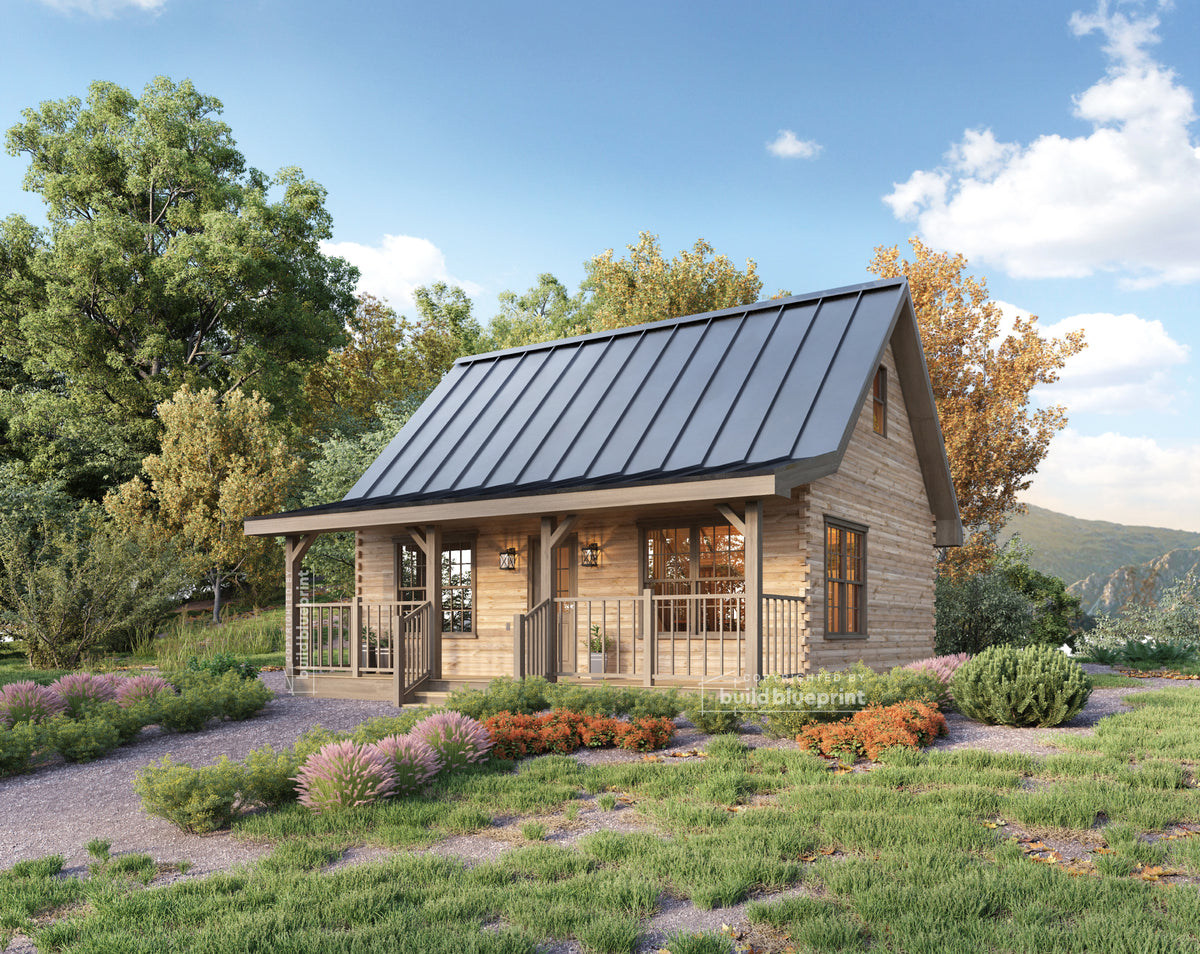

Off-grid doesn't automatically mean cheaper. You skip the utility company, but you don't skip power, water, or waste disposal — you just pay for those systems yourself, upfront, in cash. This guide breaks down exactly what you save by going off-grid, what you add instead, and how to sequence the build so those off-grid systems don't blow past what you'd have paid a utility company in the first place.
Off-Grid Savings Only Work With the Right Plan
Here's the part most "off-grid on a budget" content skips: your floor plan decides whether off-grid actually saves you money.
A custom design built around the assumption of a serviced lot — multiple bathrooms, plumbing runs split across two ends of the cabin, a layout that assumes you'll just tap into the grid — turns every off-grid system into a bigger, more expensive version of itself. Longer plumbing runs mean more pipe, more insulation to keep it from freezing, and a bigger pump. A sprawling footprint means more roof area to route wiring under before it reaches your breaker box, and a less efficient shape for mounting solar panels.
A simple, compact, standalone footprint does the opposite. One central "wet wall" backing the kitchen and bathroom together minimizes plumbing runs. A rectangular or square footprint is cheaper to frame and easier to insulate. A simple gable or shed roof gives you clean, unobstructed space for solar panels facing the right direction.
That's the whole logic behind our Budget Cabins collection — 35 plans built around efficient, standalone footprints instead of designs that assume a utility hookup down the driveway. If you're building on a serviced lot instead of going off-grid, our guide on how to build a cabin on a budget covers the general cost-cutting playbook — this article is specifically about what changes when there's no grid, no municipal water, and no sewer line.
What You Actually Save (and What You Add Instead)
This is the real off-grid math. Every "hookup" you skip has a rough dollar figure, and every off-grid system that replaces it does too. They don't cancel out evenly.
| System | Serviced-Lot Cost | Off-Grid Alternative | Net Effect |
|---|---|---|---|
| Electricity | Service drop + trenching: $2,500–$12,500 | Small DC solar: $6,000–$10,000; full AC system w/ battery + generator: $40,000–$70,000 | Often costs more off-grid unless you keep the system small |
| Water | Municipal tap: $1,000–$6,000+, plus $25–$200/linear ft to run the line | Drilled well: $6,000–$16,000+; rainwater catchment: $200–$2,500 | Catchment is a clear win; a well is usually a wash or a loss |
| Sewer/Waste | Municipal sewer tap: $1,600–$10,900+ | Septic: $3,500–$8,500 (poor soil: $4,000–$50,000+); composting toilet: $100–$3,000 | Composting toilet is the biggest genuine savings; septic can go either way |
The pattern: skipping the electrical drop and sewer tap can save real money — but only if you keep your solar system small and go composting instead of septic. Drill a well and install a full septic system on rocky ground, and you can easily spend more than a serviced lot would have cost you outright.
Cabin Shell Cost (Separate From the Systems Above)
The cabin structure itself doesn't get cheaper because it's off-grid — if anything, remote sites add cost for hauling materials. Small cabin shells (400–800 sq ft) typically run $100–$300 per square foot including labor and materials, or $40,000–$180,000+ total depending on size and finish level. DIY owner-labor and using standard dimensional lumber instead of milled logs pulls costs toward the bottom of that range.
Realistic all-in range for a small off-grid cabin: roughly $50,000 on the low end (compact shell, DIY labor, small DC solar system, rainwater catchment, composting toilet) to well over $200,000 if you scale up the cabin, add a full AC solar system with generator backup, and need a drilled well plus an aerobic septic system.
Step-by-Step: Planning an Off-Grid Build in the Right Order
Off-grid builds fail budgets when people design the cabin first and figure out water and power later. Flip that order.
- Assess the site's water situation before you design anything. Get a well driller or hydrogeologist to evaluate the water table, or confirm your catchment potential. This number alone can swing your budget by $15,000+.
- Check county permitting requirements — before you buy plans. Off-grid permitting varies enormously by jurisdiction. Some counties require a septic permit and perc test regardless of whether you use a composting toilet; some don't allow composting toilets as a sole waste solution at all. Call your local building/health department directly.
- Choose a plan with a simple, standalone footprint. A compact rectangular layout with centralized plumbing keeps every off-grid system smaller and cheaper. Browse the Budget Cabins collection, or the A-Frame Cabin Plans if a simple, steep-roof structure with a naturally compact footprint fits your site.
- Size your power system to your actual loads — not your wish list. List every appliance and its wattage before pricing solar. This decision alone is the difference between a $6,000 system and a $40,000+ one.
- Budget water and waste together — they interact. A composting toilet reduces greywater volume, which can shrink what your water system needs to handle.
- Order materials for remote delivery lead time. Rural and off-grid sites often add freight cost and delay for lumber, panels, and tanks.
- Build the shell, then install systems in dry-in order: foundation and framing, roof and exterior dried in, then plumbing rough-in, electrical/solar wiring, and finally your well/catchment and waste system tie-ins.
Money-Saving Tips Specific to Off-Grid Budgets
- Undersize before you oversize. Start with the smallest solar system that covers your real loads — batteries and panels are the most expensive line item on this whole list.
- Choose composting over septic if your county allows it. It's the single biggest documented savings, and it also cuts your water system's workload.
- Favor rainwater catchment over a drilled well where rainfall and roof area support it — the cost gap is the largest of any comparison above.
- Pick a compact, single-story footprint. Every extra foot of plumbing run and every extra roof plane adds material and labor cost.
- Mill or salvage lumber if you have standing timber or access to a salvage yard.
- Do the labor you're capable of. Off-grid systems have a lot of DIY-friendly components — panel mounting, plumbing rough-in, framing.
- Get your septic/well/composting-toilet permitting answer before you commit to a plan set. A plan is cheap to change on paper. Redesigning after a county rejects your waste system is not.
Bottom Line
Off-grid can absolutely come in cheaper than a serviced lot — but only when the cabin itself is designed to keep every system small: compact footprint, centralized plumbing, straightforward roof for solar. Get that part wrong and your "savings" evaporate into a bigger well, more panels, and longer wire runs.