
The roof is one of the most expensive components of any structure. It is also one of the few areas where a single design decision — roof form — has an immediate, measurable impact on both material cost and labor time. For a budget cabin build, this decision matters more than almost any finish choice you will make.
Here is what the different roof forms actually cost and why the gable roof wins on budget builds, consistently.
How Roof Complexity Adds Cost
Roof cost is driven by two factors: the quantity of material and the time required to cut, frame, and sheathe it. Simple roof forms minimize both. Complex roof forms multiply both — not linearly, but exponentially, because every intersection, valley, and change in plane creates a custom-cut condition that requires a skilled carpenter to measure, calculate, and fit individually.
Roofing contractors price complex roofs significantly higher per square (100 SF) than simple roofs, both for the underlayment and shingles or metal installation and for the framing work beneath.
The Gable Roof
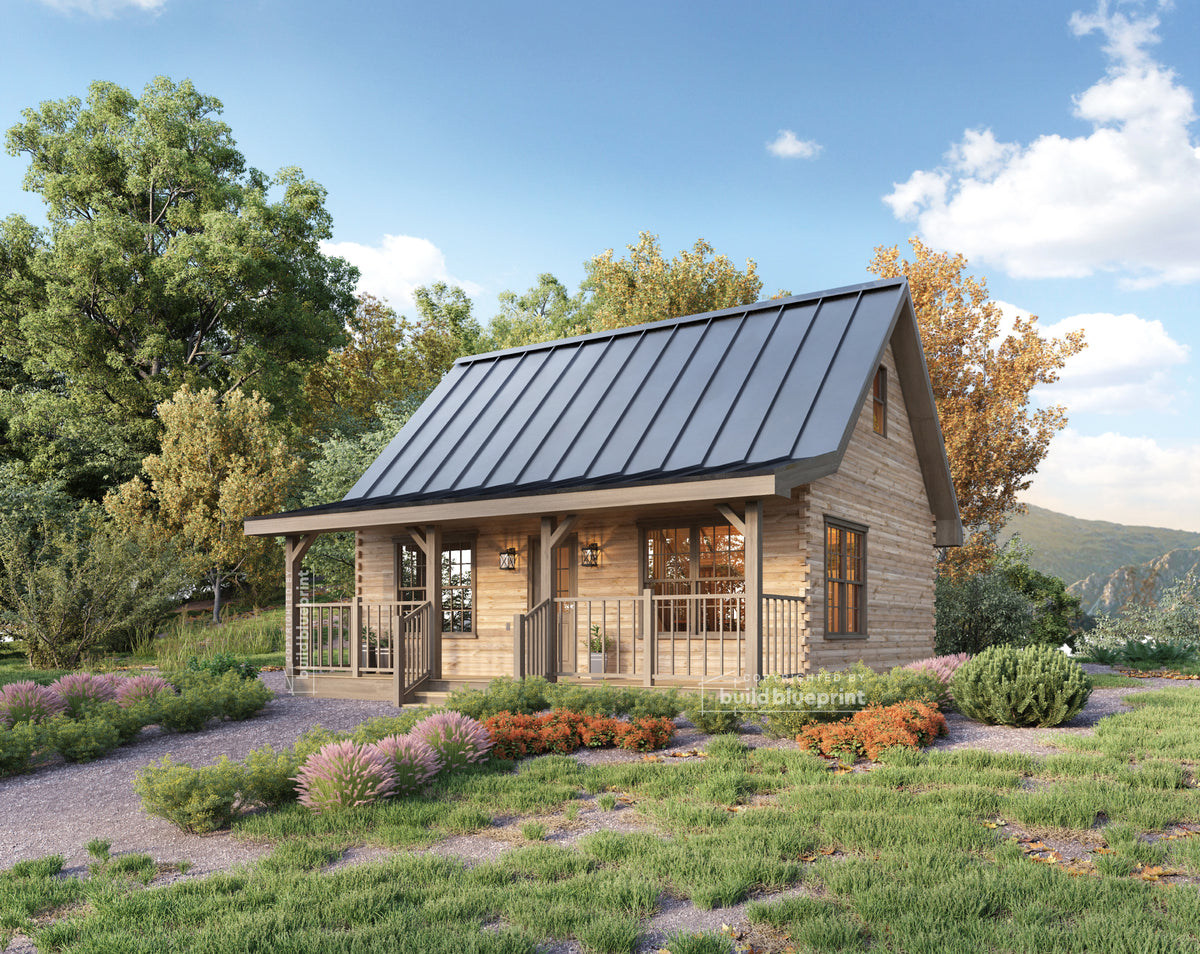
A gable roof is the simplest structural form in residential construction: two rectangular planes meeting at a single ridge, with triangular gable ends. Every rafter in a gable roof is identical in length and cut angle. A framing crew can cut all rafters from a template, reducing both layout time and cut errors. Sheathing runs in uninterrupted sheets from eave to ridge with no valleys, no miters, and no complex intersections.
For a budget cabin, a gable roof on a rectangular footprint is the correct default. It is also the form that performs best in snow country — a steep gable sheds snow efficiently — and in high-wind regions where a simple form presents less surface area and fewer edges to catch wind.
The Hip Roof
A hip roof slopes on all four sides, eliminating the gable ends. It is structurally sound and aesthetically common in American residential construction, but it costs substantially more to frame than a gable. Every hip requires custom-cut hip rafters, jack rafters of varying lengths, and compound angles at the corners. A framing crew building a hip roof cannot work from a single rafter template — every piece is different. Material waste increases and labor hours increase with it.
Hip roofs offer structural advantages in hurricane-prone regions where building codes sometimes require or incentivize them, but for most budget cabin applications, the cost premium is not justified.
The Shed Roof
A shed roof — a single plane sloping in one direction — is structurally even simpler than a gable. All rafters are identical. It is a cost-effective option for small structures and works well aesthetically on modern or Scandinavian-influenced cabin designs. The trade-off is that a single-slope roof must have sufficient pitch to shed water and, in cold climates, snow. A low-slope shed roof on a large footprint in a snow climate is a liability.
Dormers, Valleys, and Mixed Forms
Every dormer, cross-gable, or roof plane change adds a valley — the intersection between two roof planes. Valleys concentrate water runoff, require careful flashing installation, and are a primary source of roof leaks when not properly executed. They also dramatically increase framing complexity. A single shed dormer added to an otherwise simple gable roof can add $3,000–$8,000 to the total roof cost between the additional framing, sheathing, flashing, and roofing labor.
For a budget build, the rule is simple: one ridge, no valleys, no dormers. If you need additional headroom on the upper level, increase the main roof pitch or design the structure with a taller main wall rather than adding a dormer to a shallower roof.
Metal vs. Asphalt on a Budget Roof
For a simple gable, both materials are cost-effective. Architectural asphalt shingles run $3–$6 per square foot installed and carry 30-year warranties on most products. Standing seam metal roofing runs $8–$14 per square foot installed but carries 40–50 year warranties and requires essentially no maintenance. On a simple gable with long straight runs, metal installs efficiently and the price premium over a 40-year horizon often reverses when you factor in the replacement cost of asphalt at year 25–30.
On a complex roof with valleys and intersections, metal roofing becomes expensive quickly — each valley and penetration requires custom fabrication. On a simple gable, metal is a straightforward installation that any roofing contractor can price and execute.
Design It Right From the Start
Every plan in our Budget Cabin collection is designed with a simple roof form — single-ridge gables over rectangular footprints, drawn to work within standard framing and roofing workflows. You are not paying for architectural complexity that adds cost at the framing stage and maintenance liability for decades afterward.