
Framing is the phase where the two-dimensional drawings in your plan set become a three-dimensional structure. For many owner-builders, it's the most satisfying phase of the build. It's also the phase where mistakes in reading your plans — or deviating from them without engineering review — create structural problems that are expensive and sometimes dangerous to correct.
How to Read Your Framing Plans
Your Build Blueprint plan set includes a complete set of framing drawings: floor framing plan, wall framing plan (implicit in the floor plan and sections), and roof framing plan. Before picking up a single piece of lumber, spend time with these drawings and understand:
- The size and spacing of all structural members (joists, rafters, headers, beams)
- Where load-bearing walls are located — these cannot be moved without engineering review
- Where structural openings (windows, doors) are located and what headers they require
- The roof pitch and any special framing conditions (valleys, ridges, dormers)
Floor Framing
For pier and post foundations, the floor framing is the first structure that rises above grade. The sequence typically goes:
- Beam installation. Main carrying beams span between posts or piers according to the framing plan. Beam size is specified in your structural details — undersizing a beam is a structural deficiency, not a cost savings.
- Rim joists. Rim joists are set on top of the beams at the perimeter, establishing the outer boundary of the floor system.
- Floor joists. Interior floor joists are installed at the spacing shown in your plan (typically 16" or 24" on center). Joist hangers or ledger connections are used where specified.
- Subfloor sheathing. Structural plywood or OSB sheathing is glued and fastened to the joists to create the finished subfloor surface. This is the platform everything above is built on.
Wall Framing
Wall framing follows the floor plan layout precisely. The standard sequence:
- Plate layout. Bottom plates are cut and positioned on the subfloor according to the floor plan, establishing wall locations before any studs go up.
- Wall assembly. Walls are typically framed flat on the subfloor (top plate, bottom plate, studs at specified spacing, headers over openings) and then tilted up into position.
- Plumb, square, and brace. Once walls are up, they're checked for plumb and square and temporarily braced before the roof goes on. Out-of-plumb walls create problems in every finish phase that follows.
- Corner and intersection framing. Structural corners and wall intersections require specific framing configurations to provide nailing surface and structural continuity — these are shown in your plan's detail drawings.
Roof Framing
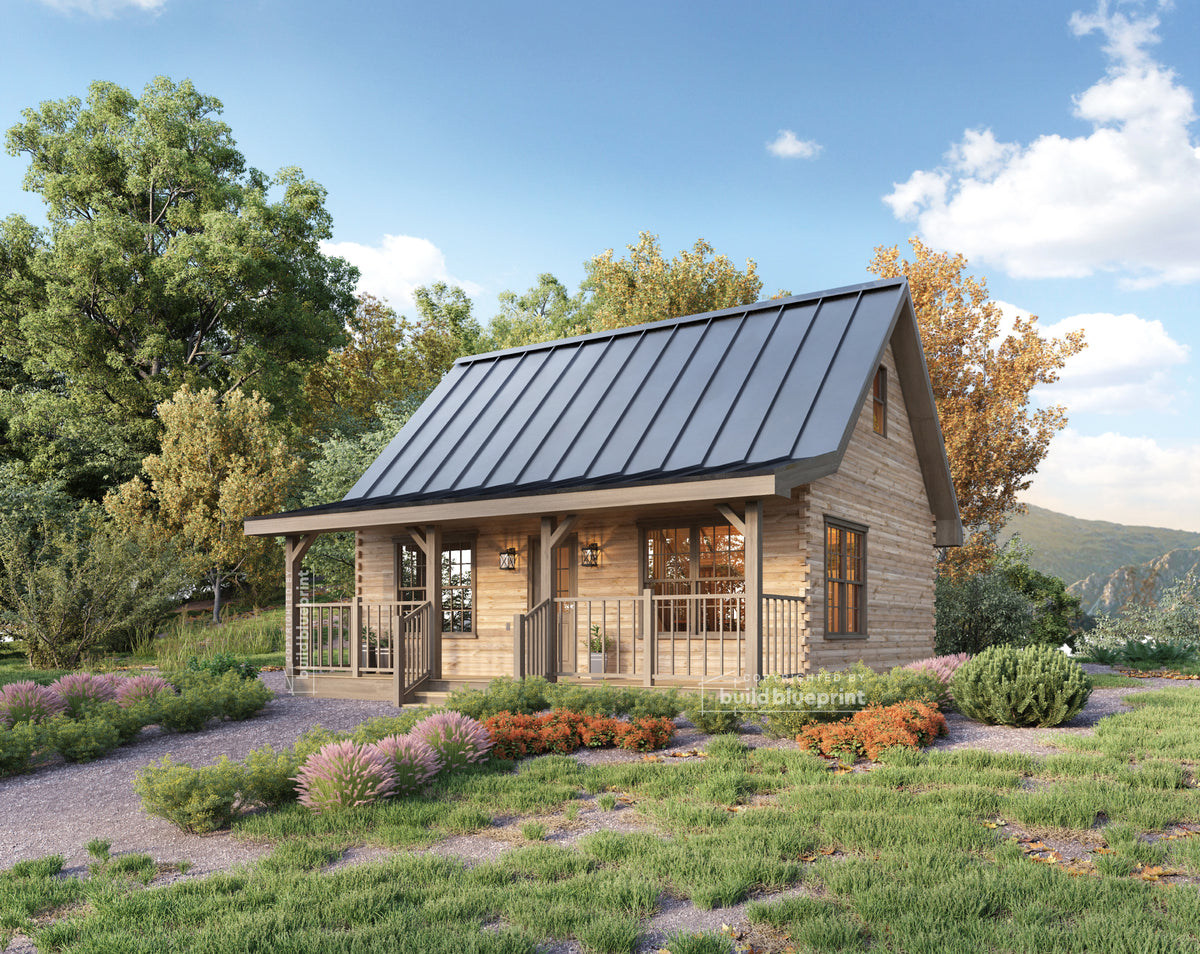
Roof framing is where plan complexity varies most between styles. A simple shed roof (like our 22' x 28' Lean Cottage) or gable roof (like our Adirondack Cabin series) is significantly more straightforward to frame than a steeply pitched A-frame or a complex hip roof.
- Ridge beam or ridge board. The ridge is set at the correct height and position according to the roof framing plan. On A-frame designs like the 24' x 36' Modern A-Frame, the ridge is a structural ridge beam carrying load — not simply a nailer.
- Rafter installation. Common rafters run from the ridge to the top plate at the specified pitch and spacing. Your plan specifies rafter size, spacing, and any required collar ties or ridge beam connections.
- Ceiling joists or collar ties. These horizontal members resist the outward thrust of the roof rafters on the bearing walls. Their size and spacing are specified in your structural details.
- Roof sheathing. Structural sheathing is fastened to the rafters to create a continuous diaphragm, which stiffens the roof structure and provides the nailing base for roofing materials.
Critical Framing Inspections
Most jurisdictions require a framing inspection before insulation or sheathing covers the structural members. This inspection confirms that framing matches the approved plans, connections are correct, and required hardware (joist hangers, hurricane ties, post bases) is properly installed. Plan for this inspection and do not cover framing before it's complete.
Where DIY Framing Succeeds and Where It Doesn't
Straightforward gable-roof and shed-roof framing is genuinely achievable for an experienced owner-builder working from clear plans. Complex roof geometries, structural ridge beams, and any framing in high-seismic or high-wind zones may require professional framing crews or at minimum an engineer's review of your work before covering up the structure.
Bottom Line
Framing is the phase where plan quality pays off most directly. Clear, complete structural drawings tell you exactly what to build. Ambiguous or incomplete plans — or deviating from the plans without engineering review — is where framing problems originate.