
The $150K cabin question is one of the most searched topics in residential construction — and one of the most misleading. The honest answer is yes, you can build a well-built, permit-ready cabin for under $150K. The longer answer is that what you get for that budget depends heavily on where you're building, how much you're doing yourself, and how you manage the decisions that eat budgets from the inside out.
Here's a clear-eyed breakdown of what different budget levels actually build — and where the money goes.
What Drives Cabin Construction Costs
Before the numbers, understand the variables that make cabin costs so hard to generalize:
- Location: Labor costs vary by 40–60% between rural markets and high-cost metros. A cabin in rural Tennessee or Texas costs significantly less to build than the same cabin in California or the Pacific Northwest — same plans, same materials, very different labor invoices.
- Site conditions: A flat, cleared lot with road access and utilities at the property line is the cheapest site to build on. A sloped lot requiring engineered retaining, a remote site requiring a septic system and well, or a site requiring significant clearing adds cost before a board goes up.
- Finishes: The structural shell of a cabin — foundation, framing, roof, windows, doors — is relatively fixed in cost. Interior finishes (flooring, cabinetry, fixtures, appliances) have an enormous range. The same floor plan can finish out at $40/SF or $120/SF depending on finish level.
- Owner labor: DIY participation on non-structural tasks — painting, trim, flooring installation, landscaping — meaningfully reduces total cost. Some buyers act as their own general contractor, which saves the GC markup (typically 15–25% of construction cost) at the cost of significant personal time and management overhead.
What $80K–$100K Builds
At the lower end of the range, in a favorable labor market, $80K–$100K builds a small, well-constructed cabin in the 400–600 SF range with a modest but complete finish package:
- Simple pier or slab foundation on a prepared site
- Standard wood frame construction, 2x6 exterior walls
- Metal or asphalt shingle roof
- Vinyl or fiber cement siding
- 1 bedroom (or open studio with loft), 1 bathroom
- Basic kitchen with standard appliances
- Mini-split HVAC
This budget does not include land, site work, septic, or well. If your site requires any of those, add them separately before doing your math — septic systems alone run $5,000–$15,000 depending on system type and local requirements.
At this budget level, owner labor on interior finishes makes a significant difference. Buyers who paint, install flooring, and handle finish carpentry themselves can achieve a noticeably higher-quality interior than those who contract everything out at the same total spend.
Plans that work well at this budget:
- 20' x 24' Budget Cabin permit-ready set — 1 bed, 1 bath, 480 SF
- 16' x 20' Redwood Cabin permit-ready set — studio with loft, 1 bath, 320 SF, DIY-optimized
What $100K–$150K Builds
This is where the budget-to-livability ratio is strongest. In most U.S. markets outside the high-cost coastal metros, $100K–$150K builds a complete, comfortable 600–900 SF cabin with a quality finish package:
- Concrete slab or crawl space foundation
- Standard wood frame construction
- Architectural shingle or metal roof
- Quality siding (fiber cement, board-and-batten, or cedar)
- 2 bedrooms, 1 full bath
- Open kitchen and living area
- Covered porch
- Mini-split HVAC or propane forced air
- Mid-grade kitchen and bath finishes
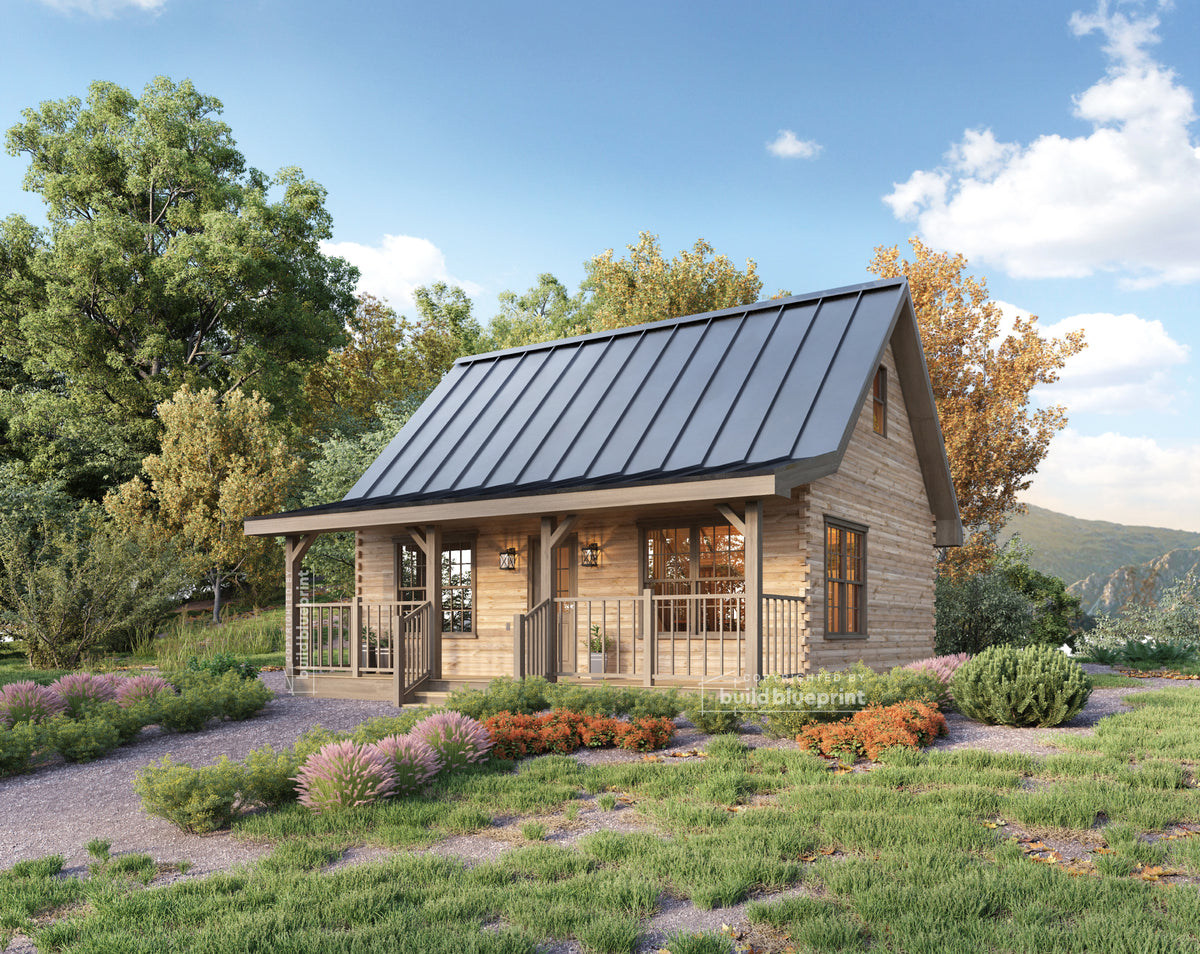
At this level, you're building something that functions well as a vacation cabin, short-term rental, or part-time residence — not a compromise structure. The 20x26 Adirondack, one of the most-built plans in the Build Blueprint catalog, falls squarely in this budget range in most markets. It has been permitted and built across the United States, with builds documented ranging from the mid-$90K range in rural Southern markets to $140K+ in higher-cost regions.
Plans in this range:
- 20' x 26' Adirondack permit-ready set — 2 bed, 1 bath, 650 SF, loft, most popular plan
- 28' x 28' Long Creek permit-ready set — 2 bed, 1 bath, 784 SF, open layout with covered porch
- 22' x 36' Catskills A-Frame permit-ready set — 2 bed, 1 bath, 792 SF, A-frame design
What $150K–$200K Builds
Moving above $150K opens the door to larger footprints, higher finish levels, and more complex site conditions. In this range you're typically looking at 900–1,200 SF with 2–3 bedrooms, 2 bathrooms, and the kind of finish quality that photographs well and commands strong short-term rental rates.
For buyers in higher-cost labor markets, this budget range is what produces the same result that $100K–$150K achieves in lower-cost markets. Location is the variable, not the plan.
Plans that work at this level:
- 32' x 32' Alpine permit-ready set — 3 bed, 2 bath, 1,024 SF, open plan with large covered porch
- 24' x 34' Large Adirondack permit-ready set — 3 bed, 2 bath, 816 SF
- 35' x 35' Hilltop Hideout permit-ready set — 3 bed, 2 bath, 1,225 SF
Where Budgets Go Wrong
The most common budget failures aren't structural — they're planning failures that show up before construction even starts:
- Underestimating site costs. Land clearing, driveway access, septic, and well are often treated as afterthoughts. They're not. Budget for them explicitly before you finalize your build size.
- Scope creep on finishes. Upgrading from standard to premium tile, cabinets, or fixtures adds up faster than any other category. Set a finish budget per room and stick to it.
- Not accounting for permit fees. Building permit fees vary by jurisdiction and are often calculated as a percentage of project value. Budget 1–3% of total project cost for permits and inspections.
- No contingency. Build a 10–15% contingency into every construction budget. It will get used. Projects that don't budget for contingency don't absorb surprises — they stall or get value-engineered in the wrong places.
- Paying for custom plans when pre-drawn plans work. Custom architectural plans for a 700 SF cabin cost $5,000–$15,000. A pre-drawn permit-ready set for the same footprint costs a fraction of that. That's money that builds finished floor instead of drawings.
How Pre-Drawn Plans Protect Your Budget
The single most effective budget move before construction is choosing a pre-drawn plan set over custom architecture. The savings — typically $5,000–$15,000 in design fees — go directly into your construction budget where they produce visible results: better materials, upgraded fixtures, a covered porch, or simply financial margin if site conditions surprise you.
Pre-drawn plans also compress the pre-construction timeline. Every month between design and permit submission is a month of carrying costs on land and financing. Getting to permit faster is a budget move, not just a scheduling convenience.
For a full comparison: Are Pre-Drawn Cabin Plans Worth It vs. Hiring an Architect?
The Bottom Line
A well-built, complete cabin is achievable under $150K in most U.S. markets — but the number only means something when you've accounted for your specific site costs, your local labor market, and your finish level. The buyers who consistently come in at or under budget start with a realistic plan, choose an efficient footprint, and put their money into structure and durability rather than custom design fees. Pre-drawn plans, a defined finish budget, and a 10% contingency are the three variables most within your control. Get those right and the $150K target is realistic for a 650–900 SF cabin that's built to last.